To understand why the market may gain momentum around November, it is helpful to look at the events that typically influence share prices from the end of the previous fiscal year through the beginning of the new fiscal year.
1. The Annual Reports and Dividend Season: Ashadh and Shrawan
Ashad is the month for anticipating the better annual financial reports of companies. And that of Shrawan is particularly important for the Nepal's only stock market NEPSE because listed companies begin publishing their fourth-quarter and annual financial reports and announcing or proposing dividends. Banks and financial institutions are especially closely watched during this period because of their earnings, capital adequacy, non-performing loans, and dividend-paying capacity. These announcements can create optimism among investors. Companies reporting strong earnings or proposing attractive dividends may attract increased buying interest, while weaker financial results can put pressure on their share prices.
2. Dividend Adjustments and Profit Booking: Bhadra and Asoj
Following the annual results and dividend announcements in Shrawan and the subsequent months, the market may enter a period of correction during Bhadra (mid-August to mid-September) and Asoj (mid-September to mid-October). Investors who purchased shares in anticipation of strong annual results or attractive dividends may decide to sell after prices have increased. When a significant number of investors take profits simultaneously, selling pressure could push share prices downward. Share prices adjust around dividend-related corporate actions. When a stock trades ex-dividend, its market price may adjust to reflect the value of the dividend distributed. Once annual financial results and dividend proposals become available, the market has more information to evaluate companies. If share prices have risen beyond what investors consider justified by earnings and future prospects, a correction may follow.
3. Why November (Kartik–Mangsir) Could Bring Renewed Buying Interest
Share market does not follows a straight forward up or down, if risen then definitely would down and vice-versa. After the market experiences possible corrections during Bhadra/ Ashoj, Kartik/ Mangsir may provide an opportunity for renewed buying interest after exhausted selling. Investors can begin assessing share prices based on updated financial information, business prospects, earnings quality, and prevailing market conditions.
First-quarter financial results of new fiscal year are also generally published around Kartik. These reports allow investors to examine revenue growth, net profit, earnings per share, and other financial indicators. If companies report improving earnings, their shares may attract additional demand. Conversely, disappointing results can create selling pressure.
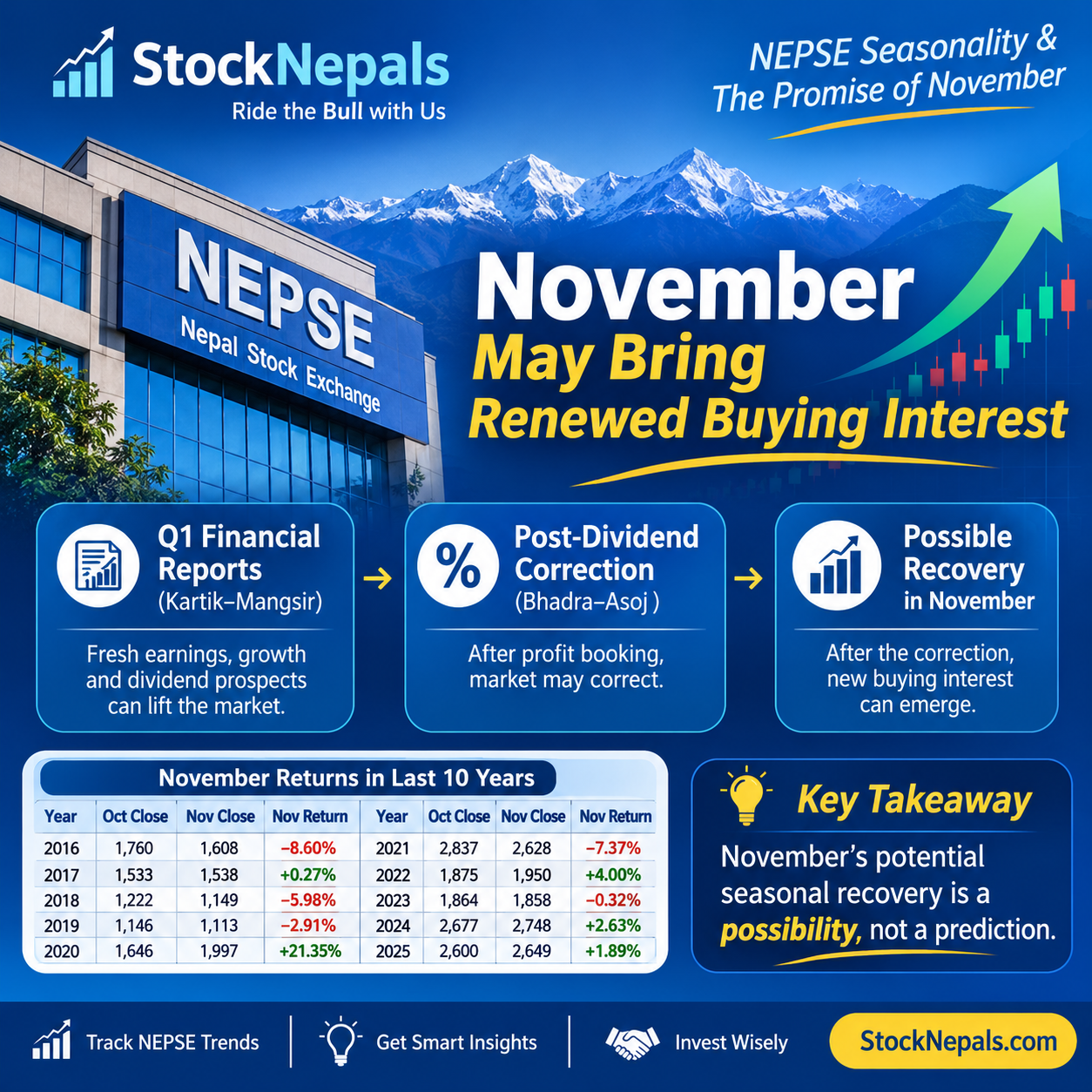
Monthly return in November in comparison to October in the last ten years:
|
Year |
October closing points (approx.) |
November closing points (approx.) |
November return |
|
2016 |
1,760 |
1,608 |
−8.60% |
|
2017 |
1,533 |
1,538 |
+0.27% |
|
2018 |
1,222 |
1,149 |
−5.98% |
|
2019 |
1,146 |
1,113 |
−2.91% |
|
2020 |
1,646 |
1,997 |
+21.35% |
|
2021 |
2,837 |
2,628 |
−7.37% |
|
2022 |
1,875 |
1,950 |
+4.00% |
|
2023 |
1,864 |
1,858 |
−0.32% |
|
2024 |
2,677 |
2,748 |
+2.63% |
|
2025 |
2,600 |
2,649 |
+1.89% |
The figures given in the above table illustrate that November recorded positive returns in five of those ten years, but the negative return in the rest of the five years demonstrates that increase in NEPSE is not guaranteed. If we observe this year's data, NEPSE has reached 2,664.06 points with turnover amounting to Rs. 7.45 Arba, with 19,397,548 shares traded as of October 28, so, we can see that NEPSE is increasing with volume. Whether this momentum continues will depend on subsequent market developments. For investors, the key takeaway is to treat November's potential seasonal recovery as a possibility, not a prediction.